A Dream Come True
Niva and I are officially a therapy dog and handler team! This is truly a dream come true for me. It has taken quite a bit of time to achieve this goal and it has been worth every second of hard work. It’s a rewarding way to give back, that’s for sure!

Since I have blogged about this journey in bits and pieces, I thought it would be nice to have the whole experience of becoming certified in one cohesive post.
What’s a Therapy Dog?
Before I get into how Niva and I became certified as a therapy dog and handler team, I thought it would be a good idea to define what a therapy dog actually is (and isn’t). This link has a lot of great info that I tried to summarize below.
Therapy dogs work with their human teammate (often the dog’s owner) to volunteer in clinical settings, such as hospitals, mental health institutions, hospices, schools, and nursing homes, where they provide comfort, trauma response, and affection in the course of their work. Therapy dogs are trained to be comfortable in new environments and to interact with different people with ease. They should have an excellent temperament, be unfazed by unfamiliar noises and movements, be comfortable being handled, and love people and being touched.
Service dogs are individually trained to perform specific tasks and to work with people with disabilities. The work of the service dog must be directly related to the handler’s disability.
Working dogs are purpose-trained canines that learn and perform tasks to assist their human companions. Detection, herding, hunting, search and rescue, police, and military dogs are all examples of working dogs.
Emotional support dogs are considered companion animals and ease anxiety, depression, some phobias, and loneliness. In order to be considered an emotional support dog, it must be prescribed by a mental health professional for a patient with a diagnosed psychological or emotional disorder.
So, as a therapy dog, Niva’s work is to provide comfort and affection in clinical and social settings. I knew she would be great at this because she is not a “typical” aloof and independent Siberian husky. She is affectionate, gentle, and friendly.
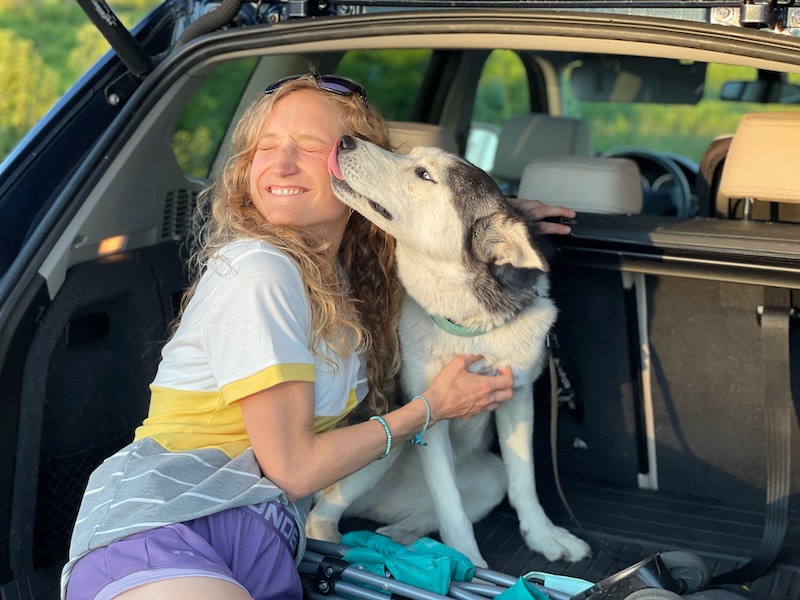
How We Became a Therapy Dog and Handler Team
After nailing down basic obedience commands with Niva, I contacted a local animal shelter that has a therapy dog training and certification program. We went in for an evaluation where our relationship was analyzed, Niva’s obedience was evaluated, and my ability to take direction was assessed.
We passed the evaluation and were then invited to take six weeks of classes where we were trained in therapy work and prepared for the therapy dog test. The first five weeks of classes focused on obedience commands, learning how to conduct therapy visits, practicing in public, and practicing therapy visits with medical equipment.
We also trained a lot with the “leave it” command because there’s always a chance we could be in a hospital and a medication is dropped. That’s an important time for a dog to “leave it!”
Our sixth week focused on a pre-test. If we passed the pre-test, we would be invited to take the actual therapy dog test. Thankfully, we passed the pre-test and went on to take the actual test! I also took a handler test online to make sure I knew how to handle different situations that may arise during visits.

The Therapy Dog Test
For our test, we went to the animal shelter on a Sunday afternoon with about five other dog and handler teams for a five-part test.
Part one focused on registration and check-in. We had to enter through a doorway without Niva busting through. She needed to be at my side and have her eyes on me. I had to check in like I would at a hospital or school–with Niva by my side, waiting patiently as I signed our names on a piece of paper. Niva was then checked over to make sure she was clean, had trimmed nails, and an appropriate collar and leash. The last section of part one was to navigate through a hallway walking past another dog and near obstacles without reacting.
Part two tested our visiting skills. We had to prove that I could position Niva well for a visit (aka she wasn’t getting her leash tangled in a walker or jumping on someone in a bed). Niva had to show that she was willing to visit with people and that she could cope with unpredictability like a crutch falling to the floor and making a loud noise.
Part three was about obedience. Niva was tested on the following commands and skills:
- Sit and down on cue.
- Staying in place while I walked six feet away.
- Coming straight to me when I called for her at a six foot distance.
- Pass walk: walking past other dogs without engaging.
- Leave it command: we walked passed a pill bottle filled with dog treats and she had to show no interest in it as I said “leave it.”
- Under control around other dogs: she couldn’t be trying to play or growling at the other dogs in the room.
- Handling assessment: a stranger had to touch her paws, body, and tail without her showing signs of aggression.
- Hug/restraint: a stranger had to hug and hold Niva in what’s called a “vet restraint” without her freaking out of growling.
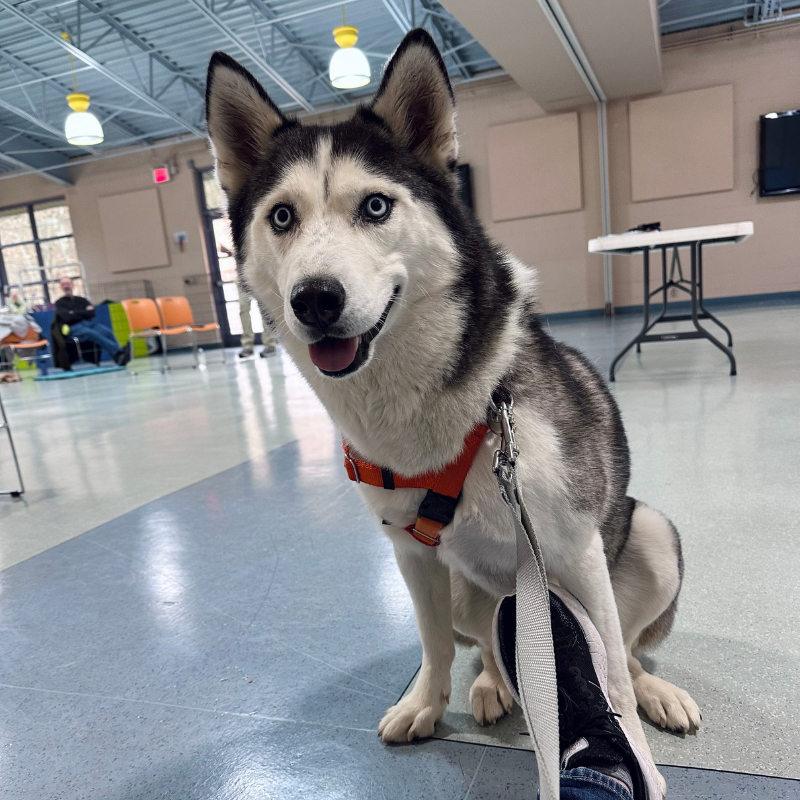
Part four analyzed handler visiting skills. Right when we walked in the door for the test, I was being observed. Was I on time? Was my appearance tidy? Did I wear the correct footwear? Did I keep Niva under control and not let her run up to people before asking if they wanted to visit? Did I keep my hand on Niva as anyone else touched her? This was to make sure I could feel her body for signs of stress before even seeing them. I was watched to see if I was polite with the people we visited with, if I asked them if they wanted to visit, if I facilitated appropriate petting, and recognized any distractions for Niva.
Part five tested handler skills. This part of the test focused on how well I as the handler focused on Niva’s needs or stress signals, how well I praised her for desirable behaviors, the tone of voice I used with her, whether or not I kept my attention on her the entire time we were being tested, and if I could control her interactions and positioning using cues and praise.
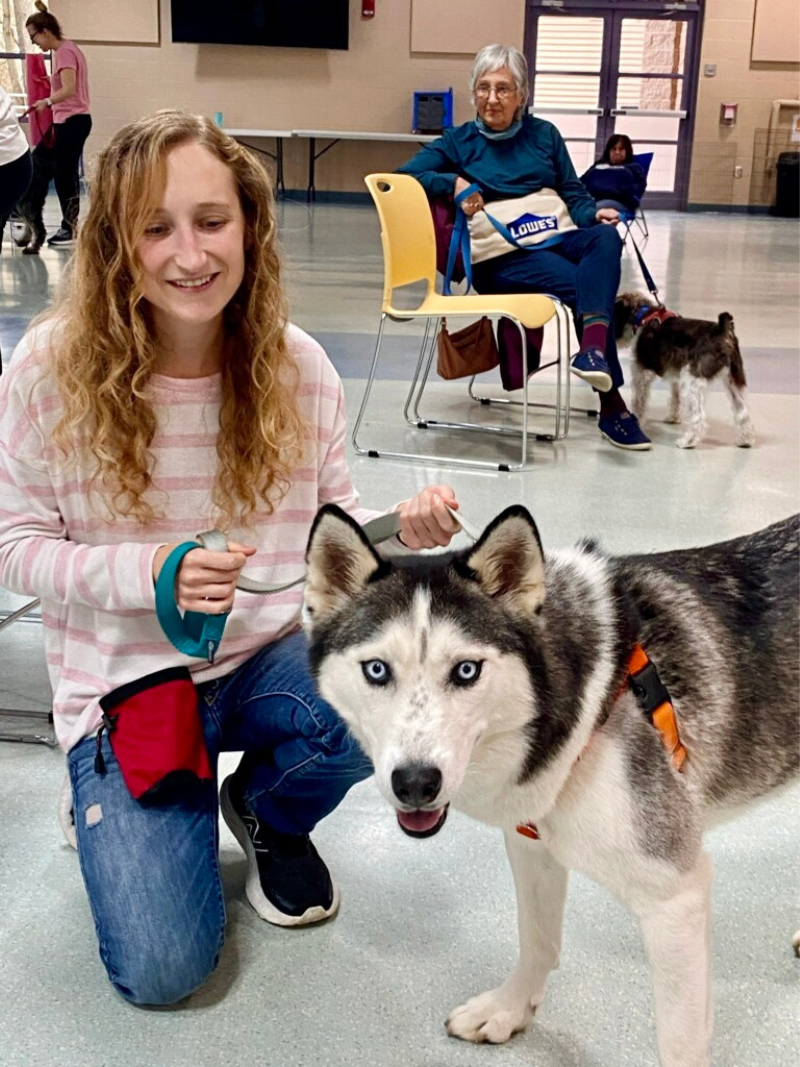
So, the test went a bit like this: we went into a large room with other dogs and handlers that were also testing. We all waited our turn to sign in, walk down a hallway past another dog and obstacles and then went into another room filled with people and medical equipment. We visited with each person in the room and I made sure to position Niva well (next to someone in a wheelchair, or to the side of someone on a bed, etc.) while keeping my eyes and hands on her and making small talk. We walked back down a hallway and past another dog and waited to for all the other dogs to finish their visits. Once everyone was back in the room, we did our obedience portion of the test.
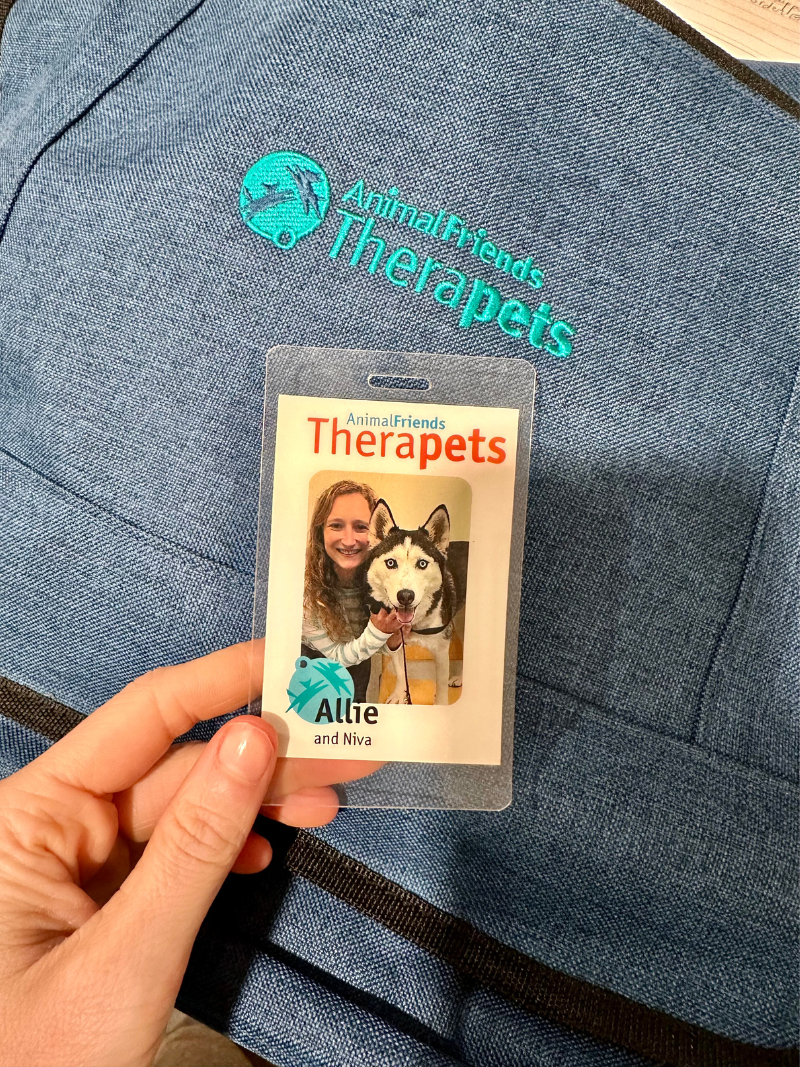
All of the above five parts of testing were addressed within the test and then the evaluators left the room to confer. They came back about ten minutes later and told us we passed! We then received our test paperwork and had our picture taken for my badge.
Paperwork and Orientations
The last step before beginning volunteer therapy work was to complete paperwork for Niva and myself and attend two orientations.
For Niva, I had to submit her annual dog license, vaccine records (DHPP, rabies, etc.), fecal exam results, our vet had to evaluate her and sign off that she was in good health and able to do therapy work.
My paperwork included submitting my Pennsylvania child abuse history clearance, Pennsylvania police criminal record check, and an FBI clearance. I also had to sign paperwork agreeing to log our hours, dress in an appropriate manner during visits, have Niva’s gear on her during visits (a tag and leash sleeve identifying her as a therapy dog), report any incidences that may occur, and that we agreed to do at least 6 visits per year to remain an active team.
The orientations for me included one specifically about being a volunteer with the shelter we did our training through and then the final orientation covered how to log our hours in their computer system, which facilities we could volunteer at, as well as going over visits and protocols one more time.
Final Thoughts
What a process, right?! It took a lot of time, effort, training, and dedication. I’m so glad we did it though! It has long been a dream of mine to volunteer in this way–with my dog!–and we actually get to do it. What a blessing.
I’ll be posting again in the future about what therapy visits are like. If you made it this far in the post, thanks for sticking with me 😊

 Living My Full Life
hey
cool blog 🙂 will give it a follow and a like !
https://ketodietrecipes.co.uk/
Thank you!
Wow! That is intense and takes patience and perseverance!
Impressive! You two are go8ng to be able to help a lot of people!
Love 💕 You
Dad
🙂
Yes, lots of work and so worth it. Thanks for always encouraging me! I love you!
Soooooo amazed by the dedication and congrats on achieving this dream. Nina is such a beautiful babe she will bring so much joy to those who need it 🥹
Thank you so, so much! I can totally see you doing this in the future!
I’m SOOO proud of you and Niva. I’m sure you will both do great helping people with their therapy needs 🙂
Love you,
Madre
Thank you so much! It has been such an enjoyable and rewarding experience thus far!